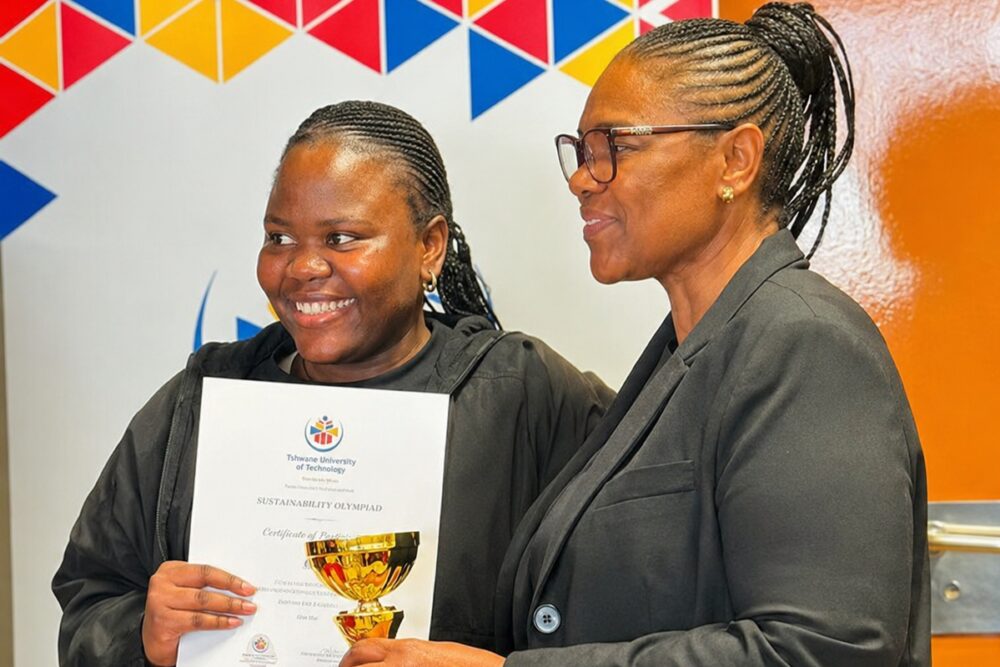
TUT students have earned a place in the regional Sustainability Olympiad after developing solutions to real-world sustainability challenges. The Tshwane University of Technology teams will now represent the institution in Kenya.
The students secured their places after taking part in the 2026 Sustainability Olympiad Process Testing Winter School and Innovation Pitch Competition at TUT from 7 to 22 July.
The programme, delivered in partnership with the University of Geneva in Switzerland, gives students an opportunity to turn sustainability ideas into practical solutions. For students, it also provides experience in teamwork, problem-solving, pitching and entrepreneurship.
The next stage will see the winning teams compete at the Regional Sustainability Olympiad Competition at United States International University-Africa in Kenya from 21 to 24 August 2026.
TUT Students Develop Solutions Linked to the SDGs
The Sustainability Olympiad brings universities, industry, governments and communities together around student-led solutions to sustainable development challenges.
The initiative is linked to the United Nations Sustainable Development Goals (SDGs). It encourages students to move beyond identifying problems and develop practical responses with potential social, economic and environmental benefits.
This approach also gives educators a way to connect classroom learning with challenges outside the university.
At TUT, students from the Faculty of Information and Communication Technology’s Department of Informatics took part under the leadership of Dr Anna Segooa, Senior Lecturer in Informatics.
She said the programme is far more than a local competition.
“The Sustainability Olympiad is an internationalisation initiative and a strategic collaboration between TUT and the University of Geneva. It brings together universities, students, industry and communities to address real-world challenges through the Sustainable Development Goals framework while promoting international collaboration, innovation and future-ready skills.”
The wider Sustainability Olympiad model similarly brings together student teams from universities across different regions to develop solutions connected to the SDGs. Research presented in 2026 describes the initiative as a global competition supporting student-driven innovation through structured activities such as hackathons and summer schools.
From Classroom Projects to Sustainability Solutions
Four student teams took part in TUT’s local competition. Each team had three minutes to present its innovation pitch and explain the sustainability challenge it aimed to address.
The projects began within the Process Testing module of the Informatics curriculum. Students identified challenges and developed their ideas during the semester.
The Winter School then gave them an opportunity to strengthen their work through design thinking, mentoring, prototype development and process testing.
Dr Segooa said the programme helped students develop their projects beyond the initial idea.
“Our students identified sustainability challenges and began developing their solutions during the semester as part of the Process Testing module. The Winter School served as a methodology to strengthen these projects with design thinking, mentorship, prototype refinement, process testing, stakeholder engagement, pitch preparation and the development of technopreneurial skills that help them transform innovative ideas into sustainable products with commercial potential and meaningful social and economic impact.”
Beyond technical knowledge, students strengthened their creativity, teamwork, critical thinking, communication skills, resilience and entrepreneurial mindset while addressing real-world sustainability challenges.
For students, this combination of academic learning and practical development can provide valuable experience before entering the workplace. It also shows how university programmes can help learners apply technical knowledge to social and environmental challenges.
TUT Teams Prepare for Regional Competition
The winning teams will now travel to Kenya for the regional competition, where they will compete against universities from across Africa.
The regional event will take place at United States International University-Africa from 21 to 24 August 2026.
The teams will then have the opportunity to progress to the International Sustainability Olympiad Finals at the University of Geneva from 6 to 9 November 2026.
The international stage gives students an opportunity to present their ideas to a wider audience and engage with peers working on sustainability challenges in different countries.
The global competition has also grown into a wider network for student-led sustainability innovation. The 2026 Sustainability Olympiad has been described as bringing together universities and educational institutions across multiple continents.
Recognition and Opportunities For Participating Students
TUT recognised all participating students during AI Week, where they received certificates for completing the Sustainability Olympiad Process Testing Winter School and Innovation Pitch Competition.
Additionally, the first- and second-place teams received Work-Integrated Learning placements from Hiteknology Solutions and Rain Cloud Group.
The Office of Internationalisation also provided goody bags for participants.
These opportunities add a practical dimension to the competition. Work-Integrated Learning can help students connect their academic knowledge with workplace experience, while the international competition offers exposure to wider networks and new approaches to sustainability.
Dr Segooa thanked the individuals and organisations that supported the initiative. She also acknowledged Dr Vathiswa Papu-Zamxaka, Deputy Vice-Chancellor: Research, Innovation and Engagement, and the Office of Internationalisation for supporting TUT’s international partnerships.
As the winning teams prepare for Kenya, their progress highlights the value of giving students opportunities to test ideas against real-world problems.
For educators and university leaders, the initiative also demonstrates how curriculum-based projects can develop technical, entrepreneurial and communication skills alongside sustainability awareness.
The TUT students will now aim to take their ideas further in Kenya, with a place in the international finals in Switzerland as the next potential step.