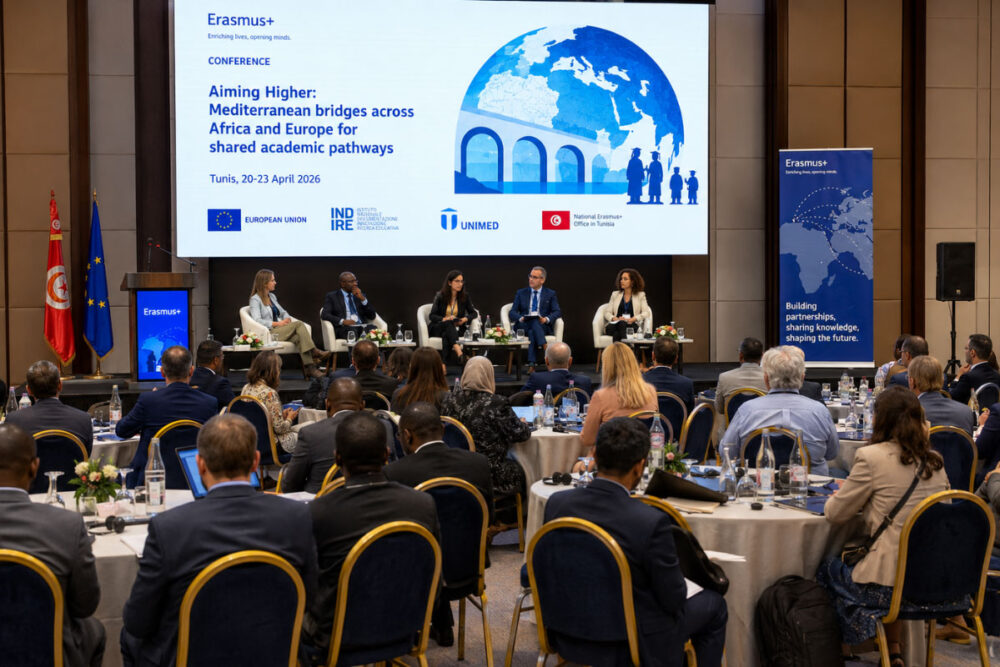
African universities are increasingly seeking to move from being junior partners to becoming project designers, coordinators and agenda-setters in higher education cooperation with Europe. That shift was at the centre of discussions during the Erasmus+ conference held in Tunis from 20 to 23 April 2026.
The conference, ‘Aiming Higher, Mediterranean bridges across Africa and Europe for shared academic pathways’, took place at a significant moment for the future of Erasmus+. Discussions continue around the shape of the programme’s next cycle for 2028 to 2034 and the role African institutions may play in it.
Moving Beyond Traditional Academic Cooperation
For decades, Africa-Europe academic cooperation was largely associated with mobility programmes and donor-recipient dynamics. However, university leaders, policymakers and institutional networks gathering in Tunis argued that the future of cooperation must be built around co-development, institutional ownership, research collaboration, digital transformation and regional capacity-building.
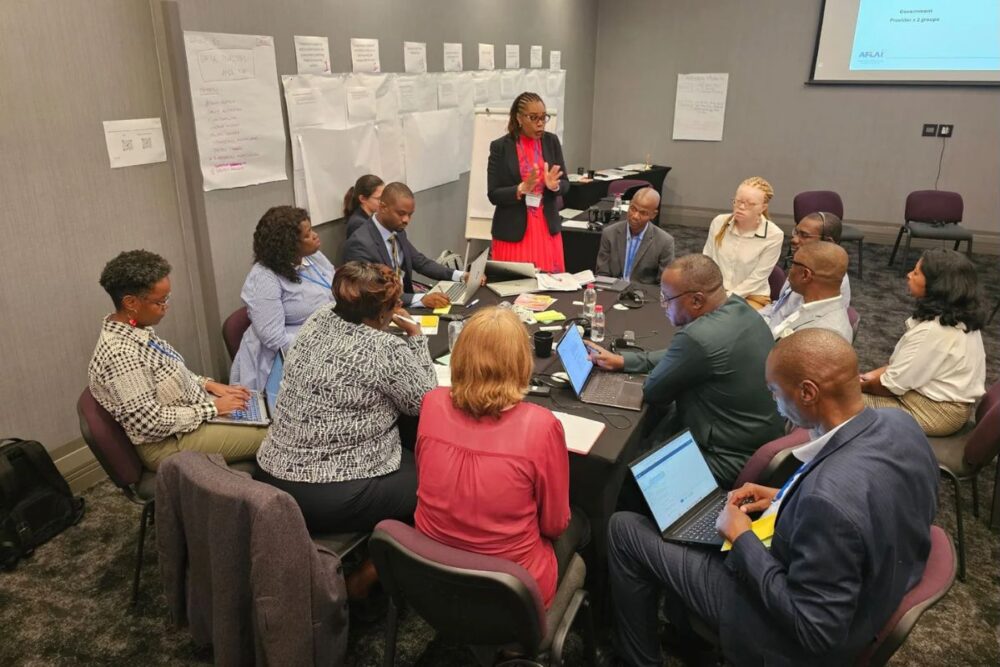
The conference was organised by the Italian National Erasmus+ INDIRE in cooperation with UNIMED and the National Erasmus+ Office in Tunisia. Stakeholders from across Africa, Europe, and the Mediterranean discussed how African higher education institutions can take leading roles in designing and coordinating international partnerships under programmes such as Erasmus+ and Horizon Europe.
Higher Education as a Strategic Priority
Dr Lavinia Monti, director of the Higher Education Internationalisation Office at the Italian Ministry of University and Research, said higher education cooperation has become a strategic pillar of international engagement with Africa. According to Monti, this approach aligns with Italy’s internationalisation strategy and the Mattei Plan for Africa, which places education, training, research, and capacity-building at the centre of co-development.
“This means moving beyond the traditional idea of mobility alone,” Monti said, pointing to investments in joint curricula, double degrees and research cooperation.
Monti also highlighted challenges linked to funding predictability, administrative complexity, fair partnerships and visa procedures.
Visa Challenges and Hybrid Learning
Marcello Scalisi, director of UNIMED, said collaboration with Sub-Saharan Africa is becoming increasingly important.
He noted that, while the European Union has increased academic funding for Sub-Saharan Africa, financial support alone cannot solve cooperation challenges. According to Scalisi, complicated visa procedures remain one of the biggest barriers facing African academics, researchers, and students. Scalisi urged,
“These obstacles should be faced at the EU level, with the identification of joint solutions that overcome single member state policies, such as the creation of an Erasmus visa.”
He also stressed that the future of academic cooperation would combine physical and digital exchange models.
“Digital alternatives cannot be used as a workaround for unresolved inequalities in access to physical mobility.”
African Universities Leading Projects
The shift towards African institutional ownership was highlighted through the GOOD MAUR-NIG project funded under Erasmus+ Capacity Building in Higher Education.
The initiative supports universities across Mauritania and Niger in strengthening their international engagement.
Professor Aliou Hamady Barry, vice-president responsible for research and international cooperation at the University of Nouakchott, said African universities are capable of leading their own projects.
“African universities have nothing to envy in other universities, particularly those of the North, when it comes to coordinating or directing a project.”
Professor Aliou Hamady Barry
The project also strengthened South-South cooperation within the Sahel region.
Digital Transformation and Research Collaboration
Digital sovereignty and reducing the digital divide remain major priorities for African higher education institutions and European partners.
Dr Letizia Cinganotto, a member of the INDIRE board of directors, said digitalisation is now a core pillar of Erasmus+ funding.
The University of Sousse in Tunisia highlighted how international partnerships are helping universities modernise through digitalisation, quality assurance and entrepreneurship-focused pathways.
Hichem Romdhani, head of the international relations office at the University of Sousse, said international cooperation should become a direct driver for local socio-economic development.
“The challenge now is to transform international cooperation into a direct driver for local socio-economic development,” he said.
Expanding Research and Knowledge Production
Conference discussions also focused on strengthening Africa’s role in global research and innovation. Scalisi pointed to the newly launched Africa Initiative IV under Horizon Europe, which allocates approximately €605.45 million for EU-Africa cooperation in research and innovation.
He also highlighted the Africa-Europe Clusters of Research Excellence as an example of more equitable scientific collaboration.
Redefining Africa-Europe Cooperation
The Tunis conference reflected broader efforts to redefine higher education cooperation around institutional ownership and shared responsibility. Sara Pagliai, head of the Erasmus+ National Agency INDIRE, said stronger networks are expected to empower more African institutions to take leading roles in future projects.
By working closely with National Erasmus Focal Points and National Erasmus Offices, the goal is to increase the number of African universities applying directly as project coordinators and chief designers in future funding calls.