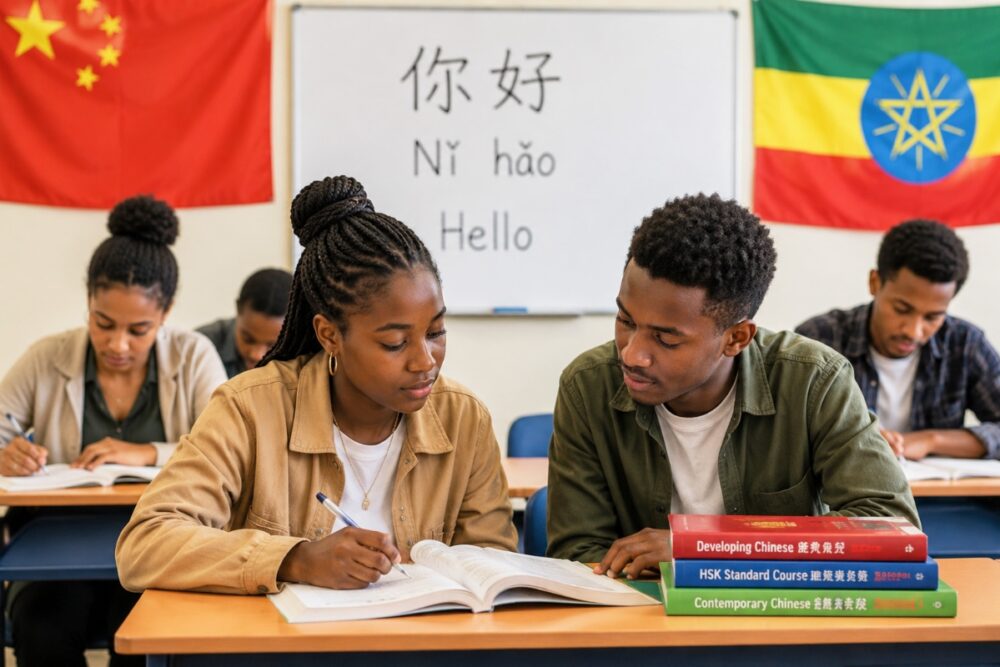
Introducing Chinese across Ethiopia’s universities could strengthen international opportunities for students. However, success will depend on careful planning, investment and ensuring the policy supports national education priorities rather than adding pressure to an already demanding higher education system.
This article is based on a commentary by Wondwosen Tamrat (PhD), Associate Professor of Higher Education and Founding President of St Mary’s University, Addis Ababa, Ethiopia.
As Ethiopia deepens its economic and educational ties with China, the Ministry of Education has announced plans to introduce Chinese as a foreign language across public and private tertiary institutions. While the proposal reflects a growing global partnership, it also raises important questions for students, educators and university leaders.
The policy could open new academic and career opportunities. At the same time, it presents practical challenges that must be addressed before implementation.
Ethiopia and China Have Built Strong Educational Ties
Education has become one of the fastest-growing areas of cooperation between Ethiopia and China.
Diplomatic relations between the two countries date back to 1970. Since then, collaboration has expanded across infrastructure, trade, technology, culture and higher education.
China is now Ethiopia’s largest trading partner and a major development partner. In 2024, bilateral trade reached US$3.55 billion, while thousands of Ethiopian students have received scholarships to study in China.
Around 3,700 Ethiopian students were studying in China during the 2022-23 academic year.
Additionally, university partnerships, staff exchanges and joint research projects have increased steadily. Ethiopia also hosts two Confucius Institutes, alongside several Chinese language teaching centres across universities and schools.
Against this backdrop, expanding Chinese language education represents another step in a long-term relationship between the two countries.
Why Learning Mandarin Could Benefit Students
Learning Mandarin could give Ethiopian graduates access to a wider range of academic and professional opportunities.
China remains one of the world’s largest economies and plays an important role in international trade, manufacturing, engineering and technology. Consequently, graduates with Chinese language skills may become more competitive in sectors such as logistics, construction, tourism, international business and diplomacy.
Furthermore, studying Chinese offers students greater cultural understanding and exposure to one of the world’s oldest civilisations. Learning a language with a different writing system can also strengthen memory, analytical thinking and problem-solving skills.
As international collaboration continues to grow, multilingual graduates are increasingly valued by employers operating across global markets.

Practical Challenges Cannot Be Ignored
Although the proposal offers clear advantages, implementation will require significant planning and investment.
Introducing Chinese into higher education means developing new curricula, producing teaching materials, recruiting qualified instructors and creating appropriate learning resources.
This is particularly challenging in Ethiopia, where there are 51 public universities and approximately 300 private higher education institutions.
Teacher availability is another important consideration. Many countries introducing Mandarin face shortages of trained language teachers, making long-term sustainability difficult without continued investment.
Moreover, Chinese is widely regarded as one of the more challenging languages to learn because of its character-based writing system and tonal pronunciation. Without clear motivation and effective teaching support, students may struggle to achieve proficiency.
Balancing Student Choice and Curriculum Demands
Universities already face pressure to deliver broad programmes within limited teaching time. Making Chinese compulsory could increase students’ academic workload and reduce time available for other important subjects or foreign languages. English continues to dominate international higher education, while French, Arabic and other regional languages also remain valuable for many students.
Therefore, policymakers must carefully assess whether Chinese should complement existing language options rather than replace them. An optional approach would allow students to choose a language that aligns with their academic interests and career ambitions without creating unnecessary pressure.
National Priorities Should Guide the Decision
Language education should support long-term national development rather than respond solely to international trends. Before introducing Chinese across the higher education sector, policymakers will need to consider labour market demand, graduate employment opportunities, institutional readiness, teacher capacity and financial sustainability.
Consultation with universities, employers and education stakeholders will also be essential to ensure the policy delivers meaningful outcomes for students.
A Measured Approach May Deliver the Greatest Value
Ethiopia’s growing partnership with China creates genuine opportunities for students and universities. However, introducing a new foreign language across an entire higher education system requires careful preparation.
A gradual rollout, supported by qualified teachers, sustainable investment and voluntary participation, may offer the most practical path forward.
Ultimately, the success of the initiative will depend not on adding another subject to university timetables, but on ensuring students gain language skills that genuinely improve their academic experience, career prospects and contribution to Ethiopia’s future development.