As educators, we have noticed how adaptive learning is increasingly becoming part of discussions across the education sector.
In this article, Dr Ulrik Juul Christensen of Area9 Lyceum explores the difference between fragile knowledge and secure knowledge, explaining how adaptive technologies can save time and support deeper learning.
What Is Fragile Knowledge Vs Secure Knowledge?
The ultimate goal of education is to support learners in reaching secure knowledge.
Fragile knowledge is scattered. It consists of facts in isolation,
- Flowers make seeds.
- Petals open and close.
- Some flowers smell bad.
These are three disconnected facts. Knowing them does not mean that a student understands why flowers exist, how plants reproduce, or the purpose of petals.
Secure knowledge is the opposite. It is built piece by piece, with the connections intact. Students do not just know what a flower does. They understand why it matters and how it links to pollination, reproduction and the survival of everything in its ecosystem.
The student who can apply what they know to understand how plants function and survive has secure knowledge. The student who aced last week’s quiz testing them on facts in isolation might not, but they may think they do.
| Fragile Knowledge | Secure Knowledge |
|---|---|
| Facts In Isolation | Connected Understanding |
| Easy To Forget | Long-Term Retention |
| Difficult To Apply | Transferrable Knowledge |
| May Create Confidence Gaps | Supports Accurate Self-Assessment |
What Is The Gap Students Cannot See?
The problem is that most students cannot tell whether their own knowledge is fragile or secure. They may feel confident about things they half-understand. Meanwhile, they may feel anxious about things they know. The gap between what they think they know and what they actually know is where learning can quietly break down.
This is unconscious incompetence. You do not know what you do not know. Traditional classrooms can struggle to support every student in attaining secure knowledge consistently.
Adaptive learning addresses this directly. When practising a learning objective, students are not just told whether they were right or wrong. They are also asked how confident they are in their response.
Over time, this practice trains calibration. Misalignment surfaces. For example, students may be overconfident in formulas but undershoot on word problems. They may think they understand Newton’s third law but consistently misapply it. This awareness of what they know is the key. Once students can see where their knowledge is shaky, they can do something about it.
They move from “I don’t know what I don’t know” to “I know exactly where I’m weak”, and from there, secure knowledge is achievable.
How Do We Meet Students Where They Are?
The other thing adaptive learning does is enable students to learn at their own pace.
If a student needs more worked examples to reach mastery on a concept, they get as many as needed. No one is rushed through something they have not grasped, and no one is held to a generic pace that is wrong for them.
It is impossible for a traditional classroom model to go at the right pace for every single pupil. Adaptive learning addresses the pacing problem at an individual level, which is the only level where it can be addressed effectively.
Two Pedagogical Models, Same Technology
The beauty of adaptive learning is that it works with the traditional classroom model.
A Year 7 maths teacher can use it to build students’ prerequisite knowledge, such as parts and wholes, on the adaptive platform at their own pace. This means the whole class can arrive in the fractions lesson on the same secure footing.
No one is lost because they missed something three weeks ago. Therefore, the teacher can use the same lesson plan with a dramatically better starting point.
Alternatively, schools can flip the classroom entirely. Students explore and build knowledge in their own time.
The classroom then becomes the place where learning conversations happen, where misconceptions surface, where students apply knowledge to real problems, and where the teacher’s expertise is used on securing understanding rather than information delivery.
The same technology can support two completely different models.
What Does This Mean For Teachers?
Back to the flower example. The students are ready when they get to class because the foundational work is already done.
The teacher is not standing in front of them reciting the parts of a flower. Instead, they are asking the questions that matter,
- Why do you think some of these flowers smell sweet and some smell rotten, who or what is each one trying to attract?
- What happens to this whole garden if the bees stop coming?
- What’s the impact we should be looking out for as pollinators decline around the world?
The students do not just recall facts. They use them as a launchpad for critical thinking and deeper learning.
How Adaptive Learning Can Support Teachers
Adaptive learning does not replace teachers. It gives them back the time and the cognitive room to do the work only they can do.
For educators, this can mean spending less classroom time addressing gaps in foundational knowledge and more time helping students apply what they have learnt.
For students, it can provide a clearer understanding of where they are confident and where they need more support. For parents, this can offer a useful way to understand how learning can move beyond simply achieving a good score on a test.
Ultimately, adaptive learning can help schools create more personalised learning experiences while allowing teachers to focus on discussion, application and deeper understanding.
About Dr Ulrik Juul Christensen
Ulrik Juul Christensen is Chairman and CEO of Area9 Lyceum and a globally recognised authority in learning technology. He is known for pioneering work in adaptive learning, data-driven content development, and simulation-based debriefing.
As chief strategist of the Area9 Group, he has led the creation of platforms that optimise business processes, drive digital product design, and deliver intelligent, adaptive learning solutions at scale.
What Adaptive Learning Tools Can I Start Exploring Now?
Hachette Learning partnered with Area9 Lyceum to develop adaptive learning platforms.
Adaptive Revise is designed for GCSE, Adaptive Study supports IB Science, and Adaptive Learn supports Cambridge International curriculums.
The system combines learner answers with self-reported confidence levels to personalise pathways, eliminate passive e-learning, and target unconscious incompetence.
Adaptive Study For IB Diploma Science
Explore Adaptive Study for IB Diploma Science.
Adaptive Learn For Cambridge International Curriculums
Explore Adaptive Learn for Cambridge International curriculums.
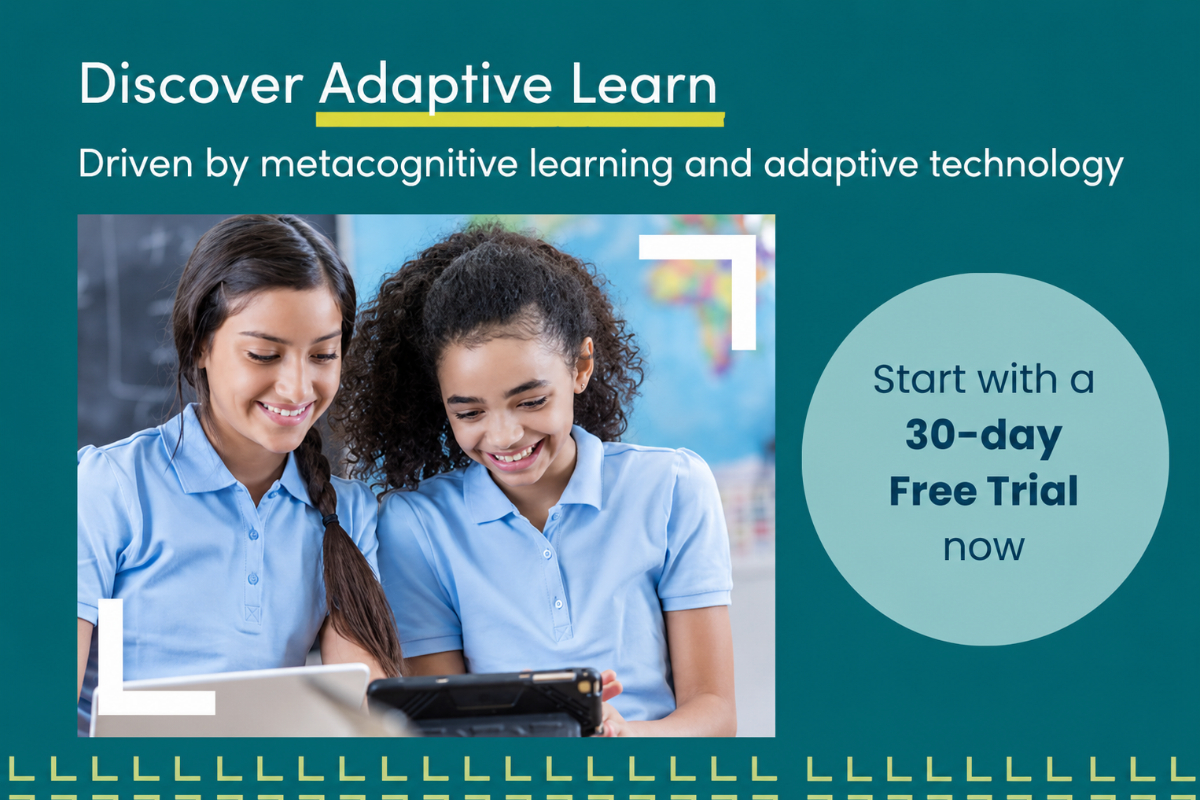
Get started with a 30-day free trial of Adaptive Learn. Explore it today by visiting