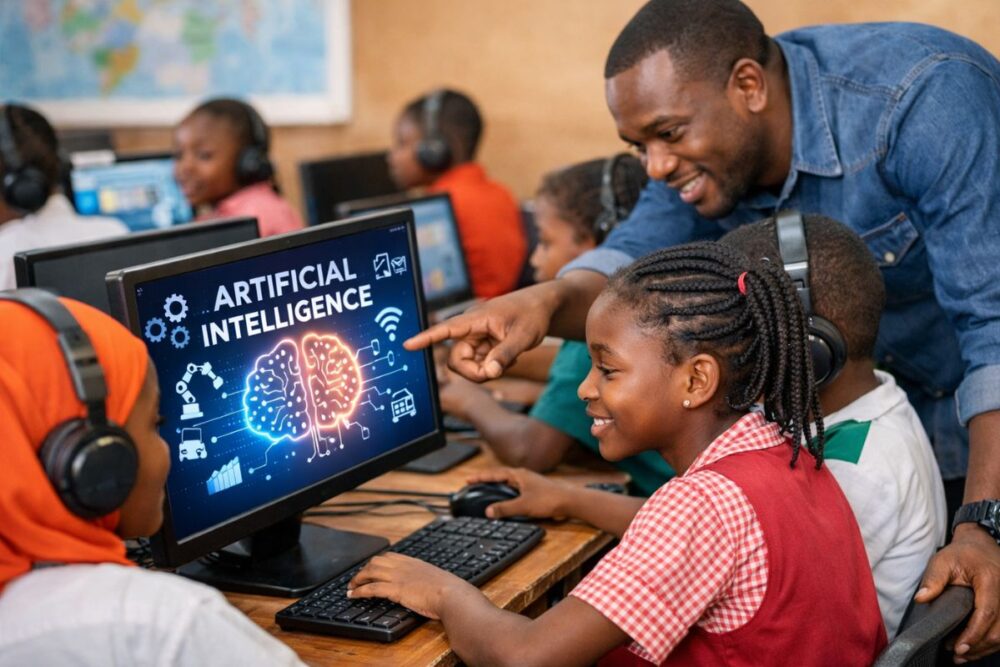
Across Africa, schools face outdated curricula and skills gaps. Experts say AI could transform learning and create new opportunities for African youth. Education Africa Magazine looks at how African nations are embracing the change. In Accra’s Chorkor neighbourhood, young Ghanaians are using computers for the first time. Inside a modest digital lab, facilitators use smart tools to teach digital literacy, skills that could transform lives.
Some students already dream big,
“I have learned a lot. I love technology and all that but coming to these classes, I have been able to gain knowledge. It has been inspirational.”
Emmanuel Dwamena Tenkorang, an IT student
American social entrepreneur Patricia Wilkins is among those investing in artificial intelligence education for underprivileged youth in Ghana. Her organisation, Basics International, runs the Chorkor Digital Lab, which teaches digital skills to young people.
“We launched the program just a few months ago, and we’ve already had one cohort of students. We’re running our second cohort and we have almost 100 students and we have three classes. Technology is the future. This is where the jobs are. This is where people can work remotely.”
Patricia Wilkins, American Social Entrepreneur
A Continental Push for AI in Education
Across Africa, similar initiatives are gaining momentum. On 5 November, over 1,500 education and tech experts gathered in Accra for the conference on AI and its impact on education.
The central theme was integrating AI into educational systems to drive transformation and unlock opportunities for young people for innovation and sustainable development. Gideon Owusu Agyemang, Ghana-India Kofi Annan Center of Excellence in ICT said, “When we talk about AI in education we are looking at technological tools that we are using to solve problems in the education environment, or we are also looking at technologies that within education systems we can use to enhance teaching and learning. We now have intelligent tutoring machines that are assisting students in their learning. AI is also going to improve teaching and learning. The use of AI would be dominant in all the education settings that we have.”
AI Fears and Opportunities in African Education
Despite optimism, some educators, especially in universities, remain wary of AI’s disruptive potential. Ekwow Spio-Garbrah, founder of the Ghana Education Trust Fund and a former Ghanaian education minister said that despite the many positives of technology and AI, Africa and its educational institutions are still crawling and must be awake to the potentials and dangers. Ekwow Spio-Garbrah, founder of the Ghana Education Trust Fund said, “I am raising an alarm. Ghana should wake up, Africa should wake up, the world would have to wake up [because] many of us are asleep. Many educational institutions are asleep. We are in a brave new world where those who build machines are getting ready to control the world.”
Spio-Garbrah said African educational institutions should also get actively involved in training and positioning the continent to own and control its own AI technologies.
Policies Shaping AI Education in Africa
To address concerns and guide implementation, experts are calling for clear policies.
“We need a policy on AI in education if there is a deliberate and specific policy around AI and education, it guides the conversation and moves us from just the discussion to actualization.”
Deborah Asmah, CEO of Npontu Technologies
Ghana is already taking steps in this direction, developing policies to guide AI education and create new opportunities for youth.
AI With African Values
Ghana’s communication minister, Sam George, stressed the importance of culturally relevant AI. Sam George, Communication Minister-Ghana said, “Artificial intelligence serves our people, reflects our values, and accelerates our development goals. We welcome collaborations, investments, and innovation, but we also insist on equity, inclusion, and respect for our digital sovereignty. AI solutions must not be built for Africa by non-Africans lest it becomes digital colonisation again.”
AI for Sustainable Development
Phoebe Koundouri, a professor of economics at Athens University of Economics and Business, sees AI as a catalyst for sustainable development. Phoebe Koundouri, Athens University of Economics and Business said, “Artificial intelligence holds tremendous potential to accelerate progress towards sustainable development goals by enabling data-driven decision making, optimising resource use and designing innovative solutions. The key is to ensure responsible and inclusive AI, guided by ethical principles, human values, and equitable access.”
Educational institutions across Africa are now offering AI courses, and learning systems are evolving to embrace smart technologies.
Amir Dossal, a former UN undersecretary-general, believes Africa is poised to lead.
“In this global race, Africa is not a bystander; you are the disrupters. Africa has the power to change dynamics by leapfrogging these outdated modules and can rewrite the rules of global AI. These are not just dreams, this is Africa’s next reality. You can offer a blueprint that can inspire others.”
Amir Dossal, Former UN Undersecretary-General