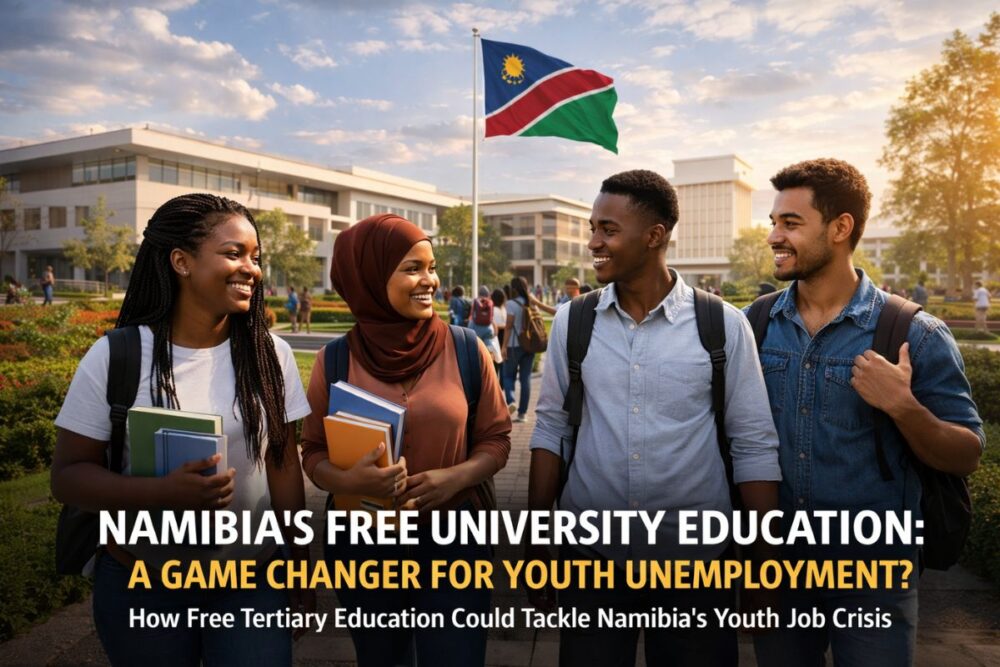
Namibia has taken a defining step in reshaping its education system by making tertiary education at state institutions free of tuition and registration fees from 2026. The reform builds on the country’s earlier foundation of free public primary and secondary education, extending state support into higher education.
For years, parents and learners raised concerns about the affordability of post-secondary education. This policy responds to those long-standing calls by ensuring that tuition no longer acts as a barrier to entry.
A Phased Approach to Free Tertiary Education
President Netumbo Nandi-Ndaitwah has emphasised that the roll-out will follow a gradual, phased-in approach. In the initial stages, students will still contribute towards accommodation and other related costs, recognising that tuition fees are only one component of the overall expense of higher education.
Non-tuition costs such as accommodation, transport, books and meals remain a major challenge, particularly for students from rural areas. Unless these costs are addressed, free tuition alone may not result in genuinely equal access.
Access Versus Quality in Higher Education
Alongside access, the issue of quality looms large. Increased enrolment could place pressure on facilities, academic staff and infrastructure. Without adequate investment in faculty, laboratories and student support services, there is a risk that educational standards may decline, undermining the promise of the reform.
Education alone does not guarantee employment. Without strong alignment between curricula, skills training and labour market needs, graduates may still face underemployment or unemployment.
Youth Unemployment and the NEET Challenge
Namibia faces one of the highest youth unemployment rates in sub-Saharan Africa. The overall unemployment rate is estimated at 36.9 per cent, but for young people aged 15 to 35 it rises to around 45 per cent. Among those aged 15 to 24, more than half are unemployed.
Compounding this challenge is the high proportion of young people classified as NEET, meaning not in employment, education or training. Nearly 42 per cent of Namibians aged 15 to 24 fall into this category, reflecting both economic exclusion and social risk.
By offering an affordable route back into structured learning, free tertiary education could draw part of this group into productive participation, with long-term benefits for employability and social stability.
How Free Education Could Alter the System
Removing tuition fees addresses a powerful barrier. Previously, students at public universities paid between N$1,900 and N$3,000 for undergraduate registration, with some programmes costing as much as N$4,500. For low-income households, these fees were a significant deterrent.
The reform applies not only to universities but also to seven state-run vocational training centres.
This places emphasis on skills that align directly with labour market needs. Technical and vocational education has long been recognised as a pathway to address shortages in sectors such as construction, manufacturing and renewable energy.
By expanding free access across both academic and vocational routes, Namibia signals an intention to tackle youth unemployment, poverty and inequality through skills development.
Despite its promise, the reform faces notable risks. Funding and sustainability remain key concerns. Free tertiary education requires long-term public financing to maintain quality, particularly at a time when Namibia’s economic growth is forecast at around 4.5 per cent amid competing national priorities.
International experience offers mixed lessons. In Scandinavia, free university education has been sustained through strong welfare systems and taxation, supporting high employment outcomes. Elsewhere, free tuition introduced without sufficient investment in infrastructure and job creation has led to graduate underemployment.
What This Could Mean For Namibia
If effectively implemented, free tertiary education could generate a ripple effect across Namibia’s economy. More young people could acquire relevant skills, the NEET population could shrink, and labour market participation could increase.
At a national level, the reform aligns with broader goals such as Vision 2030 and the National Development Plan, which aims to raise the employment rate to 75 per cent by the end of the decade. Achieving this will depend on sustained investment, careful planning and close coordination with the private sector.
Free education on its own will not create jobs. Its success will rely on integration with industrial development, support for entrepreneurship, and ongoing alignment between education and economic demand.
The decision to remove tuition and registration fees has the potential to reshape Namibia’s youth landscape. Whether it becomes a foundation for long-term economic renewal or an ambitious promise that falls short will depend on how access, quality and employment outcomes are balanced.