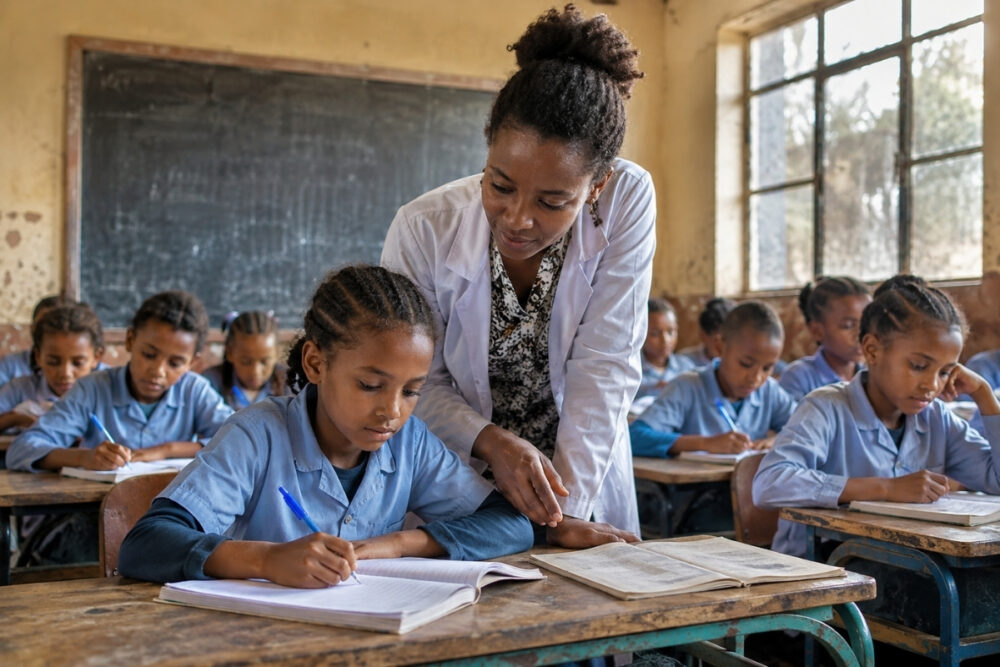
Tigray has introduced a new curriculum framework after 16 years under the previous system. However, funding constraints and shortages of textbooks could make implementation difficult for schools, teachers and students.
The Tigray Education Bureau has introduced the new Tigray Curriculum as the region prepares for the start of the new academic year. The framework aims to reflect changes in education and society while combining indigenous knowledge with modern teaching approaches.
The reform also recognises the growing influence of artificial intelligence and the changing skills students will need.
However, education officials have warned that limited funding could affect the availability of textbooks and other learning materials.
For a region whose education system has experienced significant disruption, the success of the new framework will depend on more than curriculum design. Schools will also need trained teachers, appropriate facilities, learning materials and reliable funding.
Why Tigray Is Introducing A New Curriculum
Kiros Guesh (PhD), head of the Tigray Education Bureau, said the previous curriculum framework had remained in place for 16 years.
According to Kiros, it had not delivered the educational outcomes the region had hoped to achieve. He also pointed to the impact of the war in Tigray and the damage caused to the education system.
The new framework was developed by 14 university scholars and education professionals. The bureau said the team considered educational experiences from Ethiopia and other countries.
The Tigray Curriculum is intended to respond to changes in society and technology. Artificial intelligence was highlighted as one reason for ensuring that education reflects contemporary realities.
For students, this means a stronger focus on applying knowledge and developing practical skills rather than relying mainly on memorisation.
Funding Could Affect Implementation
While the new framework represents a significant curriculum change, officials have raised concerns about the resources available to put it into practice.
Kiros said UNICEF allocated US$550,000 for the development of the curriculum framework. However, he said the bureau was able to use only around US$200,000 because of what he described as a “budget block” imposed by the federal government.
The funding limitations are now affecting textbooks and other learning materials.
Kiros warned that schools would have access to only a limited number of textbooks when teaching under the new framework begins in September 2019 in the Ethiopian calendar.
For school leaders and teachers, this creates an immediate practical challenge. A new curriculum requires more than revised learning objectives. Teachers need suitable materials to deliver lessons and students need access to resources that support their learning.
A Competency-Based Approach To Learning
The Tigray Curriculum adopts a competency-based approach.
This places greater emphasis on what students can do with their knowledge. Problem-solving, practical skills and the ability to apply learning become more important alongside subject knowledge.
The framework also incorporates ideas from international education systems.
According to the Education Bureau, the framework draws lessons on ethics from Asian countries. It also includes concepts related to balance and accountability from Nordic, Northern European and Western European education systems.
At the same time, the framework aims to preserve local knowledge.
Indigenous content and values form part of the new approach. This creates a balance between international educational practices and the cultural and educational context of Tigray.
For educators, this combination could provide greater scope to connect classroom learning with students’ communities and experiences.
New Subjects And Changes To Language Learning
The new framework also introduces changes to the subjects students study.
Teacher Gebremeskel Gebre-Hiwot, a curriculum expert at the bureau, said Ethics, known as Gibire Geb, will be introduced as a new subject for primary school students.
The framework also changes when students begin learning Amharic.
Previously, Amharic was introduced from Grade 3. Under the new Tigray Curriculum, it will now be introduced from Grade 7, according to the bureau.
These changes form part of a wider restructuring of subjects and learning outcomes.
The aim is to bring the curriculum into closer alignment with the new framework and its emphasis on competencies and practical learning.
Teacher Training Will Be Critical
Curriculum reform can only succeed when teachers have the knowledge and resources to deliver it effectively.
Teacher Kahsay Hadera, a training specialist at the Education Bureau, said the new curriculum is intended to contribute to improved educational quality.
Training for teachers has already begun.
However, the bureau has not yet indicated how many teachers will need training before the framework is fully implemented. It has also not confirmed whether every school will have the resources and personnel required when the new academic year begins.
This could be particularly important for schools that have already experienced shortages of staff and learning materials.
For educators, professional development will therefore be an important part of the transition. Teachers will need to understand the new learning outcomes, teaching methods, assessment approaches and subject changes.
Education Recovery Remains A Major Challenge
The introduction of the Tigray Curriculum comes as the region continues to rebuild its education system following the war.
Schools and educational facilities were damaged or destroyed. Students and teachers also experienced prolonged interruptions to learning.
The disruption has had consequences beyond lost classroom time. Schools have also faced shortages of educational materials and other resources during the recovery period.
The limited availability of textbooks adds another challenge.
Students may be expected to work under a new curriculum without having consistent access to the materials needed to support it. Teachers, meanwhile, may have to adapt lessons and develop additional resources while becoming familiar with the new framework.
For school leaders, managing these competing demands could become one of the biggest challenges of implementation.
What The New Curriculum Means For Students
The curriculum establishes four levels of general education.
Pre-primary education will cover children aged five and six. Primary education will cover Grades 1 to 6, followed by middle education in Grades 7 and 8.
Secondary education will cover Grades 9 to 12.
At secondary level, students will be able to pursue natural or social science streams. They will also have access to eight vocational and technical pathways, including agriculture, information technology, business and the arts.
This broader choice could give students more opportunities to connect education with future study and employment interests.
The framework also emphasises teacher professional development, updated learning materials and continuous classroom assessment.
For students, the intended shift is towards learning that places greater value on practical application, problem-solving and skills.
Can Tigray Deliver The Reform?
The new Tigray Curriculum marks an important change after 16 years under the previous framework.
Its focus on competencies, practical learning, indigenous knowledge and contemporary issues such as artificial intelligence reflects the changing demands placed on education systems.
However, curriculum ambition must be matched by resources.
Teachers need training. Students need textbooks. Schools need functioning facilities and learning materials. Education leaders also need sufficient funding to sustain the reform.
The involvement of higher education institutions, including Mekelle University, and international partners provides a foundation for the work.
Ultimately, though, the success of the Tigray Curriculum will be measured inside classrooms.
For students and families, the most important question will be whether the new framework leads to better learning opportunities. For educators, its success will depend on the support they receive to put the changes into practice.
After years of disruption, Tigray’s education system is attempting a significant reset. The next stage will be ensuring that schools have the resources needed to turn the new curriculum from a framework into everyday classroom learning.